

Social Anxiety
Let’s be objective with who you are now versus who you were back then & the things you couldn’t handle
Let’s track your social anxiety recovery and see how far you’ve come.
Have you ever looked at an old picture of yourself and couldn’t believe how much you’ve changed?
You probably don’t even recognize yourself, depending on how far back you look.
Sometimes I feel like the worst mom when I look at my son’s baby pictures — because if you lined him up on a wall next to ten other babies, I wouldn’t tell you he’s mine. He looks nothing like when he was a baby.
Looks aside, though…who were you ten years ago? Five years ago? Last year?
There’s no doubt you’ve evolved. You’ve gotten better. You might contest that and think it’s not the case for you, and that may be true — but before you put yourself down, let’s shed light together on the facts.
This post covers:
Most likely, you’ve forgotten the problems you had ten years ago.
It’s good because you don’t want to hang on to those problems while the rest keep piling on from nine years ago, then eight, and so on.
That would be a lot of problems you’d be carrying around.
No.
Chances are, you resolved many of them, and then new ones appeared. And hopefully, with each new set of problems, you’re better equipped to deal with them, and so forth, to infinity.
The funny thing about being human is that we’re always on this hedonic treadmill.
The hedonic treadmill, also known as hedonic adaptation, is “the observed tendency of humans to quickly return to a relatively stable level of happiness despite major positive or negative events or life changes.”
Technically, whatever good happens to you, you’ll get over it.
So once you found the solution to your old struggle, and it disappeared, you probably rejoiced for a while before moving on to another problem. The benefits faded from view because they got absorbed into your normal.
After all, whatever held you back back then? Pouf. It didn’t anymore.
It should come as no surprise that in your mind right now, you might think you’re not much further ahead with your social anxiety because it’s still holding you back in x, y, and z ways.
Maybe you still can’t do small talk.
Maybe you still overthink a text you sent a month ago.
But you’re probably ignoring the other ways that no longer appear on your radar because their benefits are embedded in your life now, and they no longer stand out.
You must hold hands with all previous versions of yourself to grasp how far you’ve come.
Each version brought something to the table, for better or for worse. If you hide from these previous versions of yourself because you feel shame or embarrassment, you’re not honouring the person you are today.
And you’re taking away the potential of future versions.
Technically, I could even say you have a hard time believing you’re worth knowing if that’s the case.
Here’s an example: let’s say ten years ago, all you ever wanted was to find a way to ask that one cute person out — because that was the key to solving your love problems. Having that confidence would be life-altering and would help with your social anxiety.
Then some years passed, and with trial and error, you eventually did ask (another) cute person to go out with — and they eventually became your wife, husband, or partner.
The problem of asking a cute person out hasn’t been a problem since. You cracked the code and got the key. You still possess the key, but it’s in your basement with your old high school football uniform. There’s no reason for you to venture down there. And anyway, now you’re looking for the key that unlocks your dream job because you think that with this job, all your problems will be solved.
And so on.
Hedonic treadmill, yo. Always cracking codes and collecting keys.
It might sound like you’re on your way to winning the game of life, but two things are happening behind the scenes.
The first is that when you’re on the hedonic treadmill going at 20 miles per hour, you’re super busy with the problem at hand. This problem stands in the way of your happiness, holding you back from thriving. But then, when you finally crack the code and are off the treadmill, you’re not putting the same effort into appreciating how amazing it feels NOT to have the problem anymore.
You’re already eyeing the next problem coming on the horizon, prepping yourself to get back on the treadmill.
I’m not suggesting you spend every waking hour patting yourself on the back. But if you want to spend more time off the treadmill, try to hang on to the initial feeling of relief, joy, or accomplishment more regularly.
Be nostalgic about it. Appreciate the disappearance of this old problem. Rejoice at the number of headaches gone because of it.
The second is that if you jump from one problem to another, you’re depriving yourself of acknowledging the skills and strengths you brought to the table to make that problem disappear.
There’s no time to debrief, assess, and recuperate.
So when you asked someone out, you probably had to be thoughtful, caring, and vulnerable. Traits that you had a hard time tapping into at one point. Again, it’s not about resting on your laurels — but putting your keys on display.
The best part: if you practice reminding yourself of all the keys you’ve collected, it will inspire you to think of all the future versions of you you’ve yet to unlock.
Versions that you’re currently working toward. Granted you persevere and pay attention to how you’re overcoming your current hurdles.

It’s time to stop sabotaging yourself and start believing you’re worth knowing. Get the tools you need to build social confidence, manage social anxiety, and rock conversations.
Pen and paper out (although I know you’re not budging).
The exercise is simple: for each of three timeframes — roughly ten years ago, roughly five years ago, and last year — list 3-5 specific things you struggled with that you no longer struggle with today. Or that you struggle with less.
It’s hard to remember that far back. I never understand older people who use dates and years in a conversation. If I don’t sit down, do the math, and count backward to how old I was, I’d have no clue what happened in any given year.
If it helps, anchor yourself to your life at the time. Where were you living? What was your job (if any)? Who were your closest friends?
Here are some of the struggles I had roughly ten years ago:
I know you probably haven’t grabbed a piece of paper, but I highly recommend you do, so it comes into perspective. We can’t work with what we can’t see.
Five years ago, I was in a different chapter…different country, different job, just starting to put out social anxiety content online without a real handle on it.
Some of my struggles back then:
Think about where you were five years ago and what your struggles were.
The most recent year should be the easiest to come up with. Five things, no pop culture anchors needed.
For example, the things I struggled with last year:
If you have the timeline in front of you, it should look like this: each year has its struggles or problems, and as you crack the codes, you accumulate the keys.
Do you notice anything that stands out? For this exercise to work, you have to think hard and be honest. No one will see what you write down.
If you’re having difficulty thinking of things, I can help. What are the things you need to crack the code on?

Join the free 5-day challenge and you’ll get one task each day to complete. There are 3 difficulty levels so you can set yourself up for success.
As you do this exercise, two thoughts might pop up:
Don’t beat yourself up if your thoughts lean more toward reality #2. We all have problems that are recurring, dormant, or persist throughout the years. They might not all be associated with social anxiety per se, but we all have them.
For example, I still have a hard time making genuine friends.
That doesn’t mean I’ve given up on trying, or accepted that it will always be like this, because for the past 20 years it’s been a struggle. But it’s an important point to be aware of. I can be aware of it without adding judgment on top of it.
Whatever the case may be, accept that it’s a struggle.
You can choose not to admit it, but will that do anything for you? Remember — you’re trying to hold hands with all previous versions of yourself and unlock the future versions. You’re not trying to stuff them all in a duffel bag and throw them over the bridge, are you?
Your goal should be to:
Let’s call this the evolution cycle.
Get on it, and you’ll feel more content and fulfilled with your life because you’re paying attention to the good you’ve added to it.
By “paying attention,” I mean that the keys you’ve accumulated in time are on display — as a constant reminder that you’re holding hands with all past versions of you and reaching for the hand of the future version of you.
If you’re the type of person who likes to journal, here are some prompts to keep focus on the keys you’ve collected:
These are just some things to think about to bring your progress to light and feel good about the direction you’re going in. It’s all about perspective when it comes to tracking your social anxiety.
If you want a structured way to keep stacking those keys, the Social Anxiety Challenge Workbook gives you 35 small social challenges across three difficulty levels — designed exactly to give you new keys to add to your collection.
We’re doing an exercise to be objective with how far you’ve come with your social anxiety. We’re going back 10 years, 5 years, and then taking last year into consideration as well.

I went from being scared to ask a question out loud to hosting summits online. I love coffee, French crepes, and working from home.
My mission? Help others dismantle their toxic shame so they can make friends, have conversations, and be comfortable around people!
Did you find value in my content? Buy me a coffee!
Grab the free
Shame-Resilience scan

👋 Hi, I’m Rox. Let’s work on your self-worth. More than anything, I want you to believe you’re worth knowing instead of banking on external elements making that call for you.
Like what you see here?
Check out the blog!
Must Reads
Grab these freebies

Free Challenge
5 tasks. 3 difficulty levels. Test your social anxiety through exposure therapy.
Grab these freebies

Free Template
Get the template that I personally used and create your own steps for your journey.
A podcast meant to help you be comfortably you, no matter the situation. My goal is to give you the confidence to go out into the world, share your worth, build meaningful relationships, and see yourself as highly capable. It all starts with being your awkward self comfortably.
Subscribe to the newsletter
The You’re Worth Knowing newsletter is where we practice being cringe over beige in real time.
Weekly letters to help you stop performing, start slaying toxic shame, and build a life that actually fits you – weird hobbies, awkward memories, and all.
You have successfully joined our subscriber list.

I spent years struggling with toxic shame, which often showed up as crippling social anxiety. It held me back in so many areas of my life, making me feel unworthy and paralyzed by fear. But through years of self-discovery and healing, I finally found the tools to break free from it.
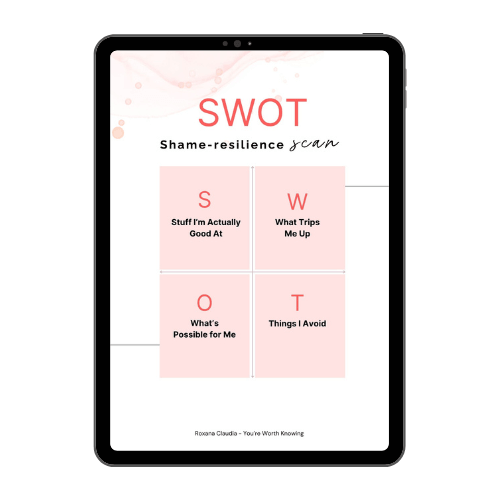
Grab this free and editable worksheet to highlight specific strengths, weaknesses, opportunities, and threats from a personal standpoint.


