

Social Anxiety
You can either take the secure or the insecure path.
If you take everything personally (every silence, every short text, every time someone forgot your name), you’re not alone. You’re also not crazy. Your brain is just running a specific loop, and it’s a loop you can interrupt.
I learned how to interrupt mine the hard way. At a massage parlor, of all places.
I’ve always considered myself a quirky person. Most likely, since at some point during a conversation, I blurt out nonsense.
This is why I like to think (usually) that people will remember me. Either because I have an interesting backstory, or I say something so strange that it sticks out to them.
Hey, finally, a benefit to having social anxiety.
So it came as a complete shock when I walked into the massage parlor this week, and the masseuse looked me straight in the eye and asked me, “Have you been here before?”
Say what?!
This was the FOURTH TIME in two months that I found myself face-to-face with her, having a conversation.
Have you ever forgotten someone you’ve talked to FOUR times? I don’t think so. And it’s not like I had plastic surgery, removed my eyebrows, or gone blonde. No. Nothing about me changed. And I’ll be honest, it hurt.
And it made me wonder: am I forgettable?
Here’s the kicker: my friend recommended me to her, and I have a strong feeling that this masseuse remembers my friend. My friend is impossible to forget. She’s that person, you know, the EXTROVERT. And then I wondered about something else — would my friend say the same thing about me?
And lastly, does any of this even matter?
Taking things personally happens when your brain takes someone else’s behaviour and runs it through a filter that says: This is about me.
The masseuse forgot you? It’s because you’re forgettable. Your friend hasn’t texted back? She’s mad at you. Your boss seemed off in the meeting? You did something wrong.
The actual evidence rarely supports any of this. The masseuse sees 30 clients a week. Your friend is busy. Your boss got bad news that morning. None of it is about you. But your brain doesn’t care, because it’s running a different program that interprets ambiguous information as judgment of your worth.
Psychologists call this personalization.
It’s one of the most common cognitive patterns in people who grew up walking on eggshells, in people with social anxiety, in people whose nervous system learned early that other people’s moods were dangerous and had to be tracked closely.
The reason it sticks around isn’t that you’re broken. It’s because, at some point, taking everything personally probably kept you safe. Now it just makes you miserable.
The good news: it’s a habit. Not a personality trait. Which means it can be changed.
The problem isn’t that one masseuse forgot me. The problem is what I do with that information.
If I take what I felt at the massage parlour and bring it along to the job interview, I’m screwing myself out of the job before I walk into the room. The spiral compounds. One small “she didn’t remember me” becomes “I’m forgettable” becomes “people don’t take me seriously” becomes “why even try in the meeting tomorrow.”
All this wondering about being unforgettable increases the chances of social anxiety tagging in another (more important) encounter. Because here’s the thing: this masseuse planted a seed in my head that’s hard to root out.
No one wants to be forgettable, especially after running into someone FOUR times.
So now, I’m making it a THING in my head. And this THING makes me feel inadequate. Boring. Plain. Unworthy. And I’ll carry these feelings along with me in other situations as well, hence screwing myself over.
But there is a way to break free from this train of thought. And, you know, not awaken the social anxiety beast inside.
So if you currently feel like this, or will sometime in the future, here’s what you do:
The You’re Worth Knowing newsletter is where we practice being cringe over beige in real time.
Weekly letters to help you stop performing, start slaying toxic shame, and build a life that actually fits you – weird hobbies, awkward memories, and all.
You have successfully joined our subscriber list.
The idea behind taking the secure path is that you take away their power over you. You shift the focus back on them, because they are the ones drawing a blank.
Ultimately, it has nothing to do with you and how forgettable you are.
Here’s how to cement the secure path in your mind: create the backstory and place the burden on them.
Let’s take the secure path by describing my masseuse’s backstory. Heck, let’s do several backstories for funsies.
Backstory #1: Maria probably sees 4 to 5 clients daily, every day of the week. And has for years on end. At some point, she decided she didn’t want to connect with her clients since they were all unpredictable and eventually left town. She might even have been burned by getting too close to one. This, in turn, makes her oblivious to whoever lies on her table.
Backstory #2: Maria’s had the worst week of her life. Everything fell apart at home, yet she still had to make her way to work. Damn. She hadn’t slept in weeks and couldn’t care less who was paying for a massage with her.
Backstory #3: Maria is one of those people I read about in psychology studies. She doesn’t remember faces very well. She has THAT syndrome.
As you can tell, you can make up an infinite number of backstories to explain the phenomenon of forgetfulness — or any other exhibited behavior. This works with any doubts inflicted by others.
If your brain is always landing on “they hate me” after every interaction, the science of the Liking Gap is worth a read. It’s the data showing that yes, your brain is lying to you.
Taking the insecure path means you choose to believe there’s something wrong with YOU.
There’s something (or nothing) about you that makes you forgettable. You’re just a sad little plain Jane, and that’s all you’ll ever be. That’s probably the nicest thing you’re saying about yourself.
Here are the other things you choose to tell yourself on this path:
“Even after 3 conversations, Maria draws a blank because, let’s face it, nothing is exciting about me. Nothing stands out. I probably need to walk in here naked or painted like a dragon to make her remember who I am.”
“I knew it. Who am I kidding? I will always be seen as the quiet little mouse no one notices. Not like my friend, who seems to attract every single person she runs into. I’ll never be that cool.”
As you can see, taking the insecure path means projecting negativity onto yourself as if you’re the problem.
I’ll never know why she didn’t recognize me, what made me “forgettable.” We’ll never know why someone doesn’t like us, text us, or hire us. All we can do is take control of the narrative and move on.
And what do you want to bet that taking the insecure path not only DOESN’T let you move on, but the more you find yourself on it, the more likely you’ll become all those things you’re thinking?
We are what we think. (Or was it what we eat?) You know what I mean.
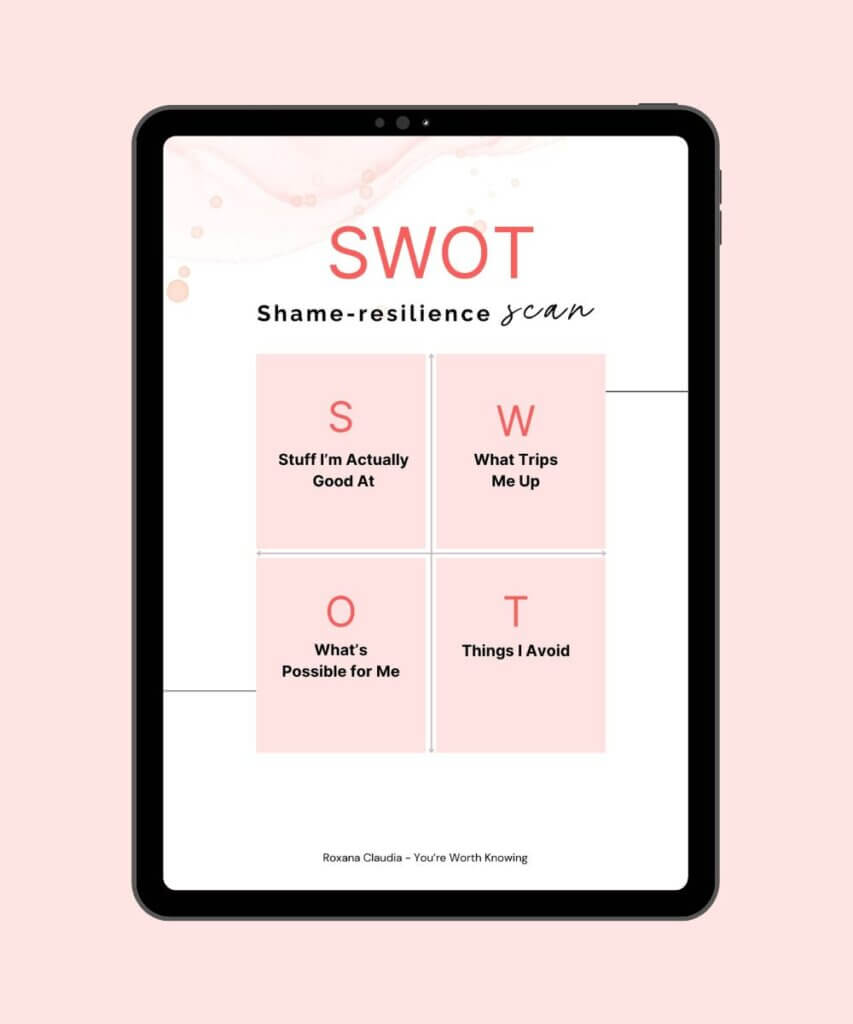
The free Shame-Resilience Scan is the worksheet I built to give the other voice a microphone… the one that knows what you’re actually good at, even when shame is louder.
Check your inbox to download the free template!
Knowing about the secure path and actually taking it are different things. Your brain has been running the insecure path on autopilot for years, so it’s the default route. Choosing the secure path takes practice. Here’s how to make it stick.
The moment you notice the spiral starting (she didn’t text back, he sounded weird, they didn’t laugh), that’s your cue. Name it out loud or in your head: “I’m doing the thing.” Just naming it interrupts the autopilot. You can’t change a pattern you don’t see.
Don’t let your brain stop at one explanation. The insecure path always finds ONE story (it’s about me) and locks in. Make yourself generate three alternative backstories, whether they be boring ones, weird ones, sad ones, whatever. The point isn’t to find the “true” one. The point is to break the “everybody hates me” thought.
If you can imagine three plausible reasons that have nothing to do with you, your brain stops treating its first guess as fact.
If you’re not 100% sure what someone meant (and you rarely are), give yourself 24 hours before you assign meaning. Most of the time, you’ll find out in those 24 hours that it was nothing. Or you’ll have cooled off enough to ask, “Hey, are we okay?” without the spiral having already done its damage.
You don’t need to rehash a conversation 14 times after it ended. You really don’t. Every replay is a workout for the insecure path, building it stronger. The conversation is over. You’re allowed to stop coaching yourself on what you should have said.
If you want a structured way to actually practice this — small, low-stakes situations to test the secure path on — my free 5-Day Social Anxiety Challenge gives you one tiny task per day. They take less than 10 minutes each, and several of them are designed for exactly this kind of brain.
Real question, because sometimes things ARE personal. Sometimes someone IS upset with you. Sometimes the behavior IS a message.
The rule of thumb: take something personally only after you have actual evidence, not before.
Actual evidence looks like:
Not evidence:
If you don’t have actual evidence, you’re not making an informed call; you’re running the insecure path and dressing it up as intuition. There’s a difference between reading the room and projecting your worst fears onto the room. The first is a skill. The second is the loop.
So do yourself a favour and choose the secure path every time.
I’m curious to see what massage #5 will bring.
If you want to make this kind of reframe a habit instead of a one-off, the Social Anxiety Challenge Workbook walks you through 35 small social situations across three difficulty levels — each one designed to give your brain new evidence that the insecure path is lying.
After going to a massage parlor and talking to the same masseuse a total of four times, she still didn’t recognize me. It made me wonder “am I forgettable?” In this article, I’m walking you through the two paths you can take to address this question.
The secure path comes with creating narratives around why this person is acting this way.
The insecure path comes with putting the blame on yourself and justifying how it’s your fault that they forgot you.

I went from being scared to ask a question out loud to hosting summits online. I love coffee, French crepes, and working from home.
My mission? Help others dismantle their toxic shame so they can make friends, have conversations, and be comfortable around people!
Did you find value in my content? Buy me a coffee!
Grab the free
Shame-Resilience scan

👋 Hi, I’m Rox. Let’s work on your self-worth. More than anything, I want you to believe you’re worth knowing instead of banking on external elements making that call for you.
Like what you see here?
Check out the blog!
Must Reads
Grab these freebies

Free Challenge
5 tasks. 3 difficulty levels. Test your social anxiety through exposure therapy.
Grab these freebies

Free Template
Get the template that I personally used and create your own steps for your journey.
A podcast meant to help you be comfortably you, no matter the situation. My goal is to give you the confidence to go out into the world, share your worth, build meaningful relationships, and see yourself as highly capable. It all starts with being your awkward self comfortably.
Subscribe to the newsletter
The You’re Worth Knowing newsletter is where we practice being cringe over beige in real time.
Weekly letters to help you stop performing, start slaying toxic shame, and build a life that actually fits you – weird hobbies, awkward memories, and all.
You have successfully joined our subscriber list.

I spent years struggling with toxic shame, which often showed up as crippling social anxiety. It held me back in so many areas of my life, making me feel unworthy and paralyzed by fear. But through years of self-discovery and healing, I finally found the tools to break free from it.
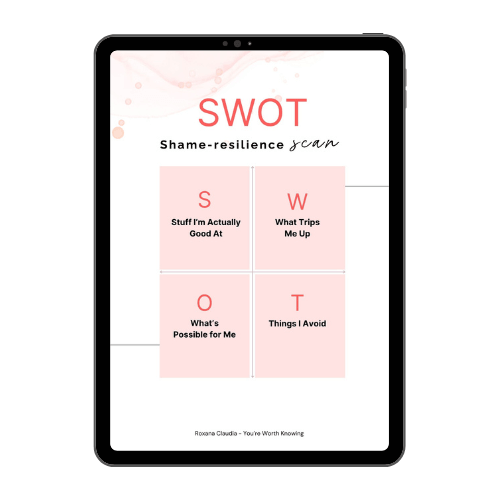
Grab this free and editable worksheet to highlight specific strengths, weaknesses, opportunities, and threats from a personal standpoint.


