

Social Anxiety
A personal story (made out of two situations) that made me come to this realization
I don’t know about you, but I’m in my 30s and just now am I starting to have more compassion for myself. To be less strict, judgmental, and demanding of myself.
If you’ve been wondering how to accept yourself and not in the cheesy Instagram quote sense, this post is a checklist of what it looks like in practice.
I can honestly say I’ve spent most of my life not practicing any self-acceptance. I spent most of it tearing myself apart, wishing I were anyone else.
From the smallest thing of not liking my name for a long time (when I was a child, I was a huge fan of the show The Secret World of Alex Mack, and I fell in love with the actress’s real name, Larissa, so I desperately wished for that to be my name) to the much larger issue at hand of hating I was an introvert.
I spent years and years wishing so badly that I could be like my extroverted best friend.
The ultimate extrovert who crashed onto strangers’ couches because she became best friends with people the moment she landed in a foreign country. The extrovert who wasn’t fazed at making a fool of herself, showing up authentically, telling people off, and simply being so comfortable in her skin that she didn’t care about what anyone thought of her.
It’s been a long road to self-acceptance for me.
And on some days, I still struggle with remnants of old versions of myself. They keep popping up when I least expect them and make me feel like I haven’t grown one bit.
Although now I have so many tools in my repertoire to help me cope when I feel like I’m about to go into destruction mode.
Here’s the thing: self-acceptance isn’t a single moment of arrival. It’s not a graduation ceremony. It’s a series of small, quiet shifts that you notice in retrospect.
You don’t wake up one day and accept yourself. You wake up one day and realize you didn’t spiral after hearing your voice on a recording. Or that you didn’t over-explain yourself in a comment thread. Or that you apologized for something genuinely small and it didn’t ruin your week.
In this article, I want to highlight some signs of self-acceptance; the kind that show you’re actually doing the work, not just talking about it.
While some are minor, others require a lot of effort and work to achieve. And that’s okay. This life is a journey toward understanding oneself, and there’s no need to rush through it.
The sound of my voice was the main reason it took me so long to show up online the way I badly wished to (also because I was super insecure about my accent).
I think it’s a fact that most of us don’t like how we sound; it’s a psychological factor. Hearing our voice can make us self-conscious about how we sound to others.
This can trigger embarrassment or criticism about our speech we hadn’t noticed before, like pronunciation, pitch, and tone.
We might focus on perceived flaws or quirks in our speech that others might not notice or care about.
Here’s why this is a sign of self-acceptance:
It reflects a comfort with self-perception and a reconciliation of the difference between internal and external perceptions of oneself.
According to studies in cognitive psychology, people who are comfortable with their recorded voice demonstrate a higher level of self-acceptance and a lower level of self-criticism. This is because they’ve harmonized their self-perception with external feedback, which is an important aspect of self-acceptance.
Usually, when I run into a situation where I’m being misunderstood (usually after every post I make online), and I feel this intense need to defend myself and over-explain my point of view, I remind myself if I’m being attacked due to a misunderstanding on their part, then that’s not on me.
I cannot control what someone else thinks about something I said, and I won’t waste my time trying to correct them just to make myself feel better.
Chances are, they’ll double down on their perception, and nothing I say will change their mind.
Here’s why this is a sign of self-acceptance:
This indicates a secure sense of self and an understanding that your worth isn’t dependent on someone’s approval or understanding.
Psychologically, this aligns with the concept of self-differentiation, which Murray Bowen, a psychiatrist and pioneer in family therapy, described as the ability to separate feelings and thoughts. High self-differentiation means a person can maintain a strong sense of self even when misunderstood by others.
If you know, you know.
I spent years in corporate America feeling worthless because of the mistakes I made. Because of my manager’s expectations. Because of colleagues criticizing me.
I’d come into work, looking forward to a productive day, only to leave at the end of the day hating myself. It was a never-ending cycle I couldn’t break. Until I left.
That was my solution: to give up.
Instead of working through my limitations, I explained my unhappiness and lack of self-worth away in the actions of others.
Here’s why this is a sign of self-acceptance:
This suggests a healthy separation between actions and intrinsic self-worth.
According to Carl Rogers, a founder of humanistic psychology, unconditional self-acceptance is key to mental well-being.
Realizing that your worth isn’t tied to every action, especially regarding disappointing others, is a sign of mature emotional intelligence and self-compassion.
If your default move when someone seems annoyed with you is to spiral into “what did I do,” this post on how to stop taking things personally walks through the reframe.
This is hard for the best of us. Admitting we made a mistake, hurt, or wronged someone is not an easy feat.
There is no “easy” setting for this.
For the majority of my life, I either resorted to pretending that nothing happened, sweeping it under the rug, hoping that enough time would pass to make things right, or that the person would just forget it and move on.
Very cowardly moves for sure.
I also employed the silent treatment. Anything to not admit guilt.
These days, I’ll be the first to apologize to you. To admit that I made a mistake and will do better next time. And it’s SO empowering. It’s scarier to hide from a mistake than to take it headfirst.
Here’s why this is a sign of self-acceptance:
Admitting to mistakes or acknowledging when we’ve wronged someone is deeply tied to self-acceptance because it requires a level of self-awareness and honesty.
It’s about recognizing our own imperfections and taking responsibility for our actions. This process isn’t just about acknowledging our faults — it’s also a reflection of our strength and maturity.
By admitting mistakes, we’re essentially saying that we understand and accept ourselves as flawed, yet capable of growth and improvement.
A study conducted by Winkler and Fishbach found that failure to admit mistakes often stems from the threat it poses to our ego and self-esteem. When our self-esteem is threatened, we tend to stop learning from our mistakes. This is because admitting mistakes can evoke feelings of shame, which is closely linked to low self-esteem.
Consequently, people may hide their mistakes from others, which not only prevents them from learning but can also exacerbate the situation.
One of the most challenging yet liberating signs of self-acceptance is the ability to share a flaw or insecurity openly.
It’s about stepping into the light, revealing parts of yourself that you’ve previously kept hidden. This was a big step for me. I remember the first time I talked openly about my fear of public speaking in a group of people.
It was daunting, but the moment I voiced it, a weight lifted off my shoulders. It’s not about seeking validation or sympathy; it’s about owning every part of yourself: the good, the bad, and the in-between.
Here’s why this is a sign of self-acceptance:
By acknowledging and sharing your insecurities, you confront them head-on, which is a brave act of self-acceptance.
Psychologically, this aligns with the concept of vulnerability, which Brené Brown identifies as a strength. It’s a form of courage that leads to greater connection with others and, more importantly, with yourself.
It’s a significant milestone when you can react inappropriately to a situation and not spiral into deep shame.
Of course, recognizing and correcting your behavior is important. But understanding why you reacted a certain way is crucial.
For instance, I used to beat myself up for days after reacting sharply in stressful situations. I realize these reactions often stem from past experiences or deep-seated fears. Understanding this allows me to address the root cause rather than just the symptom.
Here’s why this is a sign of self-acceptance:
This demonstrates a high level of self-awareness and emotional intelligence. It means you’re not only accepting your imperfections but also understanding them.
This understanding is key to self-growth. According to emotional intelligence theory, knowing why we feel and act the way we do is crucial for developing healthier coping mechanisms and improving our interactions with others.
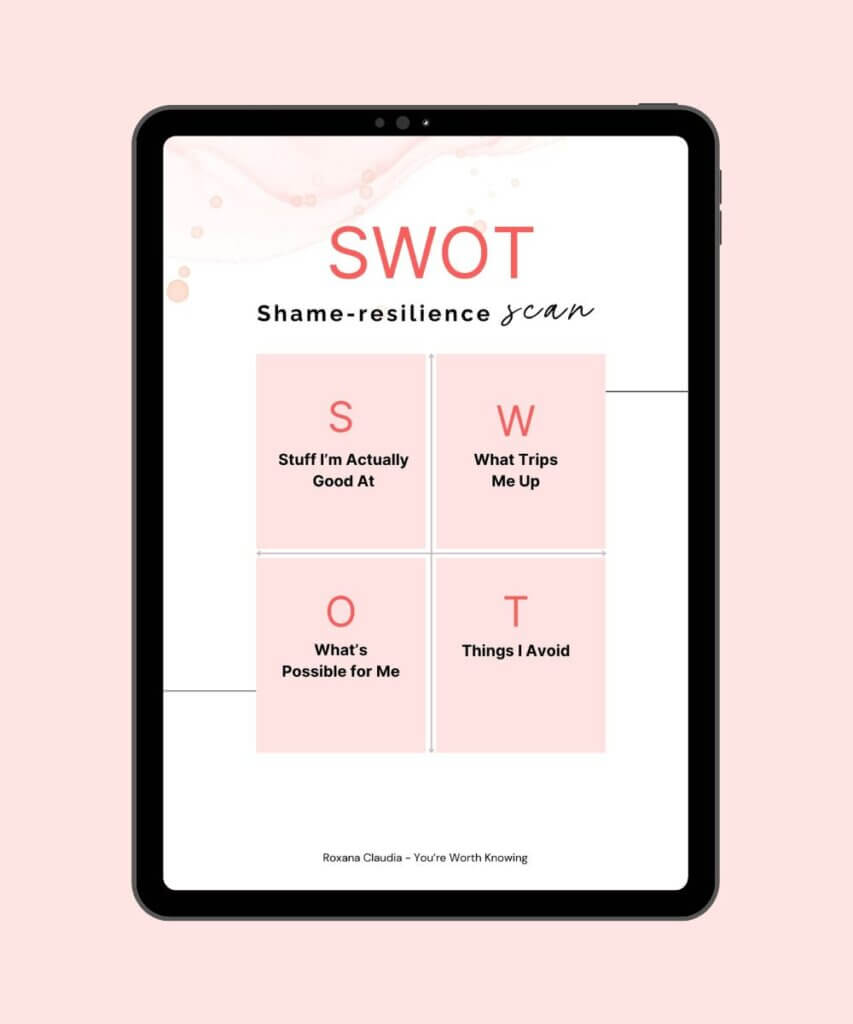
The free Shame-Resilience Scan is the worksheet I built to give the other voice a microphone… the one that knows what you’re actually good at, even when shame is louder.
Check your inbox to download the free template!
If you can do these 6 things without wanting to beat yourself up at the end of the day, then you’re on solid ground. You’re homies with yourself.
If you’re struggling with some of them, that’s fine.
How we feel about ourselves can fluctuate depending on the season. The goal is to reach a place where we can rely on self-acceptance to guide us through difficult moments.
The last sign is mostly for when you react, or you’re triggered by someone (I had to think of my kids and how I sometimes lose it), and you’re able to assess why it happened, so you can rest at peace with yourself. That you’re working on it and accepting where you’re at in the journey.
Here are some practical ways you can strengthen your self-acceptance:
1. Embrace your alone time. Make peace with who you are and not the version of yourself you adapt to others.
2. Pursue self-care in a way that makes sense for you. I learned long ago that what makes me happy is not necessarily the same as what other people enjoy. I also learned that some of what might be healthy for others is unhealthy for me, and vice versa.
3. Sit with all emotions, especially the negative ones. Rather than trying to suppress or ignore these emotions, allow yourself to experience and process them fully.
4. Practice self-compassion. Recognize that perfection is an unrealistic goal. Sure, try to be better, but try more to accept yourself now.
What do you think of the six self-acceptance signs I described? Do you struggle with any, all, or none?
Where are you in your journey to self-acceptance, and what’s still standing in your way?
If this kind of identity work resonates with you, my Substack is where the longer-form thinking on worthiness, shame, and who we get to become lives. Free to subscribe.
There are 6 signs of self-acceptance (that I’ve identified from my personal journey with it). With each sign, you read to see why I attached self-acceptance to it.

I went from being scared to ask a question out loud to hosting summits online. I love coffee, French crepes, and working from home.
My mission? Help others dismantle their toxic shame so they can make friends, have conversations, and be comfortable around people!
Did you find value in my content? Buy me a coffee!
Grab the free
Shame-Resilience scan

👋 Hi, I’m Rox. Let’s work on your self-worth. More than anything, I want you to believe you’re worth knowing instead of banking on external elements making that call for you.
Like what you see here?
Check out the blog!
Must Reads
Grab these freebies

Free Challenge
5 tasks. 3 difficulty levels. Test your social anxiety through exposure therapy.
Grab these freebies

Free Template
Get the template that I personally used and create your own steps for your journey.
A podcast meant to help you be comfortably you, no matter the situation. My goal is to give you the confidence to go out into the world, share your worth, build meaningful relationships, and see yourself as highly capable. It all starts with being your awkward self comfortably.
Subscribe to the newsletter
The You’re Worth Knowing newsletter is where we practice being cringe over beige in real time.
Weekly letters to help you stop performing, start slaying toxic shame, and build a life that actually fits you – weird hobbies, awkward memories, and all.
You have successfully joined our subscriber list.

I spent years struggling with toxic shame, which often showed up as crippling social anxiety. It held me back in so many areas of my life, making me feel unworthy and paralyzed by fear. But through years of self-discovery and healing, I finally found the tools to break free from it.
Grab this free and editable worksheet to highlight specific strengths, weaknesses, opportunities, and threats from a personal standpoint.


