

Social Anxiety
Here’s my hot take on this
Knowing the root cause of social anxiety is a great starting point to learn how to manage it. For most of us, it’s a blur.
Maybe you can pick up an event here or there from memory that you think had an impact on your developing social anxiety, but it goes much deeper than just one or two events in your life.
There’s a Reddit Thread titled “I’ve always been like this,” and this person talks about how, for as long as they can remember, they’ve been terrified of people, although there’s no recollection of any event creating this fear.
Someone replied saying there was probably no event at all, they also have always had it, and it’s the way we are wired.
No. No. No.
This is when you need to be wary of people’s opinions.
We are WIRED for social connection. We are WIRED to seek out others. We are NOT wired for isolation and fear of others.
We know this because well science.
Let’s start at the top to get to the root cause of social anxiety.
The other day, I cringed at how my kids interacted with each other and their friends.
Ignoring each other, dismissing each other’s feelings, pushing, screaming, calling out names, “You’re a baby, no, you’re a baby!” “Leave me alone.” “I wish you had never been born!” “Go away,” and then 5 minutes later, everyone is skipping along, loving each other.
I’m sure you’ve seen this if you have children or remember being a kid. Not attaching any kind of significance when you were blown off by someone, because the next day, you were back at their house playing as if nothing happened.
It’s almost as if, at that age, we’re immune to social rejection.
Now a piece of me dies inside when I see my kids behaving like this.
My social anxiety kicks in, thinking I need to mend the relationship, address the feelings, and make sure everyone feels included, but there’s no need for any of that.
They automatically fix it themselves by moving on. At some point, though, it becomes more complicated.
Research shows that around age 5, we develop a sense of “reputation” – we start thinking about what others think about us.
A study concluded that the liking gap begins when children are 5 years old when they first become concerned with other people’s evaluations of them.
In a way, that’s good, right? It helps us hone our social behaviour to feel like we’re part of the group, can make friends, and so on.
5-year-old children start to manage their reputations, behaving more generously when others observe them.
The dark side of this is that depending upon our environment during our formative years can lead to social anxiety. To the loss of our authentic selves.
What I mean by environment is anything we’re exposed to regularly in childhood that can have an adverse or positive impact: family, teachers, friends, sub-culture, religion, to name a few things.
Imagine a 5-year-old who is more concerned about what others think about him.
If he has good influences in his life — parents who instill a sense of pride and ownership over his actions and allow him to freely express himself without backlash — he’ll be less likely to develop social anxiety.
Compared to if he had parents who place high value on appearance, “proper” behaviour, achievements, and so on. Or who are overly critical or controlling.
This also goes for teachers. Some are capable of embracing and applauding a child’s individuality and quirks. Others put those down, which unfortunately happens way too often.
A child that grows up hearing:
…or similar phrases will begin to internalize that there’s something off with him and that he needs to shut that down.
Having people tell you constantly what they think about you is quite traumatic, to say the least.
Additionally, being surrounded by people who are “judgmental” of others has huge implications.
Growing up hearing people judge others they don’t know negatively can make someone internalize the message that “everyone is judging everyone else,” so, of course, they’re judging me too, and here I am, not being good enough.
Everything I’ve just described makes up childhood trauma. A big contributing factor to the root cause of social anxiety.
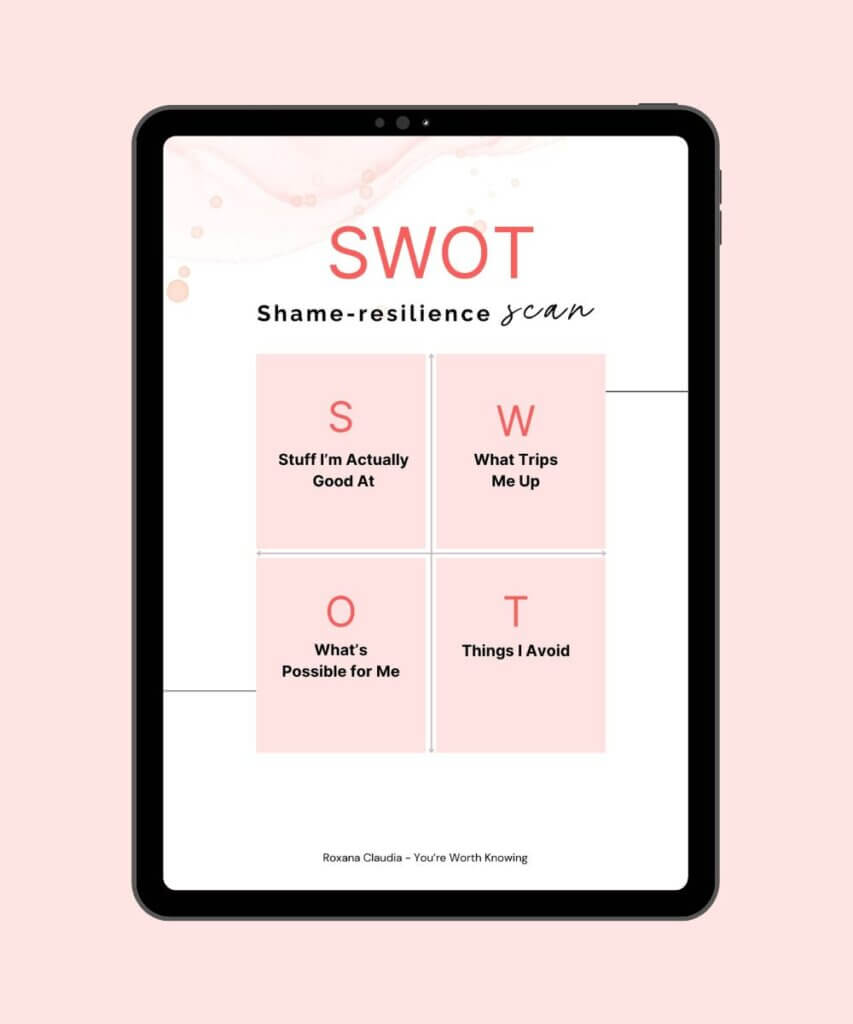
The free Shame-Resilience Scan is the worksheet I built to give the other voice a microphone… the one that knows what you’re actually good at, even when shame is louder.
Check your inbox to download the free template!
Here are a few ways that childhood trauma can manifest in social anxiety later on:
Many people mistakenly believe that trauma is only related to domestic violence, sexual abuse, tragedies, or big events with a definite before and after.
The truth is that little t trauma slowly seeps and builds up in us without awareness.
It accumulates through time and becomes a part of us that we end up on a Reddit board telling someone on the other end that their social anxiety is probably unrelated to any event, and it’s how we are wired.
And in a way, that Reddit reply is half right.
Social anxiety was wired into that little kid, unknowingly. And maybe because he was more sensitive, aware, or insecure, and without the right people around, social anxiety slowly crept in and built up.
This is where biological factors (brain chemistry and structure, family history) and temperamental factors (shy or more introverted) can contribute to the root cause.
As this kid grows up and becomes a teenager, without intervention, social anxiety grows through bullying, isolation, unhealthy relationships, and more trauma.
Self-esteem takes a hit, and he’ll start caring way too much about what everyone thinks of him.
From such experiences, we fear being judged for who we are. We learn how to wear a mask (a different one for each person we encounter b/roll of shots with different play masks on, and end up unable to be our authentic selves in adulthood.
Instead, we show up as a shell of ourselves to make others comfortable.
And that perpetuates social anxiety because the less we can freely express ourselves, the more constricted we get and the more frustrated we are.
We’re conditioning ourselves around social anxiety. And from that come other emotions we’re not too keen on: shame, sadness, fear, jealousy, emptiness, and guilt.
(as an FYI, you don’t need to have all of these, but it’s a good starting point to check which ones you can relate to)
If one were to, let’s say, grow a social anxiety plant, these would be the 4 essential elements they’d need.
Now, it’s great to gain insights into what happened in the past and how those experiences affect you now, but insights won’t explain what’s currently driving your social anxiety.
So now that you have more clarity over the root cause, the next burning question you need to ask yourself is:
“What’s keeping my social anxiety alive and kicking?”
That question is one I’ve been writing about on my Substack, because the answer goes deeper than this post can hold; it pulls in toxic shame, the plant analogy I’ve been developing, and the question of why understanding the origin still doesn’t make the anxiety go away.
If this post has clicked something into place for you, that’s the next thread to pull.
For now, take time to review your memories and truly process them. Remember the details and the events, and try to connect them to your feelings today.
See if you can have a few a-ha moments. I’d love to hear them.
If you want a more practical way forward — actually working with the social anxiety rather than just understanding it — the Social Anxiety Challenge Workbook gives you 35 small social challenges across three difficulty levels, based on the exposure therapy approach.
I’m answering the question “What is the root cause of social anxiety?” which basically boils down to a mix of the following factors:

I went from being scared to ask a question out loud to hosting summits online. I love coffee, French crepes, and working from home.
My mission? Help others dismantle their toxic shame so they can make friends, have conversations, and be comfortable around people!
Did you find value in my content? Buy me a coffee!
Grab the free
Shame-Resilience scan

As a social anxiety expert I share my best strategies and tips that I’ve learned on my journey to help you manage your social anxiety.
Like what you see here?
Check out the blog!
Must Reads
Grab these freebies

Free Challenge
5 tasks. 3 difficulty levels. Test your social anxiety through exposure therapy.
Grab these freebies

Free Template
Get the template that I personally used and create your own steps for your journey.
A podcast meant to help you be comfortably you, no matter the situation. My goal is to give you the confidence to go out into the world, share your worth, build meaningful relationships, and see yourself as highly capable. It all starts with being your awkward self comfortably.
Subscribe to the newsletter
The You’re Worth Knowing newsletter is where we practice being cringe over beige in real time.
Weekly letters to help you stop performing, start slaying toxic shame, and build a life that actually fits you – weird hobbies, awkward memories, and all.
You have successfully joined our subscriber list.

I spent years struggling with toxic shame, which often showed up as crippling social anxiety. It held me back in so many areas of my life, making me feel unworthy and paralyzed by fear. But through years of self-discovery and healing, I finally found the tools to break free from it.
Grab this free and editable worksheet to highlight specific strengths, weaknesses, opportunities, and threats from a personal standpoint.


