Social Anxiety

How to Talk to Strangers (And Why You Should Want To)

We tend to overestimate how awkward it is and underestimate how nice it is to talk to strangers

Let’s talk about why you should go out of your way to talk to strangers. 

Chances are you’re going out of your way not to talk to strangers; I know the feeling.

Some things that probably come to mind when you talk to a stranger are the awkward silence, the dreaded small talk, and the high expectations.

But hopefully, after you hear what I have to say, you’ll see conversations with strangers in a different light and want to talk to strangers. 

It’s time to stop having negative associations with strangers as if all they want to do is feed us poisonous candy.

What if I were to tell you that conversations with strangers can be surprisingly satisfying?

 Sounds crazy, right? 

We’re so focused on how awkward it will be that we deliberately avoid making the effort to have a deeper conversation at the start. 

And then we die inside making small talk.

Remember, you have permission to skip the small talk! A meaningful conversation, even with a stranger, is just that…meaningful. 

We want to have more meaningful conversations, yet we overestimate how uncomfortable we’ll be and underestimate how much we’ll enjoy them.

The Science: Talking to Strangers Goes Better Than You Think

What if I were to tell you that psychologists have studied this? 

Psychologists have predicted that conversations between strangers feel less awkward and create more connectedness and happiness than even the participants themselves expected.

In one study, the researchers conducted twelve experiments with more than 1,800 participants to examine the degree to which others are interested in connecting through conversation with strangers.

What they found was that quote: 

“Before speaking, people expected strangers to be relatively uninterested in the content of the conversation. Yet after speaking, people indicated that the person they spoke with was more interested and caring than they expected. As a result, people felt more connected and happier after speaking with a stranger than they had anticipated, and deep conversations between strangers felt less awkward than expected as well.”

Deep conversations between strangers tend to go better than people expect.

Those chats with people you don’t know — when you’re in line for coffee or on the bus — are usually way better than you’d think.

Whether the talk is about deep stuff or just chit-chat, it’s not as awkward as people usually expect. And the best part? People feel more connected and have a better time than they thought.

The researchers then tested another hypothesis: they had participants engage in shallow conversations with one stranger and deep conversations with another.

What do you think happened? Most participants expected to prefer the shallow conversation. After having both, they preferred the deep one.

Both deep and shallow conversations with strangers feel less awkward than expected. How interesting is that?

The real reason talking to strangers is easier than talking to friends

So let’s move a bit away from its technical aspects and think of it more practically.

Let’s imagine two scenarios. 

Scenario 1: Meeting a friend back-to-back.

You go out to dinner and catch up on everything. Then you meet again the next day. You can find other things to discuss, but you’ve exhausted many of your thoughts and stories.

Here’s why this can be hard:

  • If you have social anxiety, the thought of meeting on consecutive days can be mentally taxing
  • You might dread meeting again or feel pressured to say something to skip the awkward silence
  • You might prefer to leave some time between meetings so you actually feel you have something to talk about


Scenario 2: A conversation with a stranger.

You end up at a friend’s birthday party or your child’s playdate, and you sit down next to a stranger. You realize you have many things in common. Time flies.

Here’s why this can be easy:

  • Endless possibilities for a conversation; you’re more curious and engaged

  • It’s a blank slate, so you can feel free to ask any questions and talk about yourself

  • The “liking gap” is on your side

Remember the liking gap

The liking gap is when we meet someone new, they probably have no expectations of us, whereas we have ridiculously high expectations of ourselves. 

Studies show we fall short of our expectations but exceed theirs.

Even if you’re self-critical, even if you feel awkward, the liking gap is a good reminder that the chances are high after a conversation with someone new that they like you and vice versa. Even if you don’t think they did.

We’re the ones holding ourselves back from engaging more meaningfully because we’re wary and scared of opening up to someone new (AKA a stranger) and that we’ll potentially be seen as awkward lunatics.

This isn’t about divulging where you buy your lingerie. It’s about moving past the weather, sports, and pop-culture gossip and getting to a place where you’re energized by the conversation.

And it seems that most of us DON’T BELIEVE that’s possible with a stranger or a new acquaintance, but based on this study that was conducted, we’re FOOLING ourselves!

Think about it. They don’t know anything about you. It’s a blank slate. Curiosity takes precedence. Chances are that no matter what you share, they’ll be glad to have met you!

Okay, rant about why over. Let’s talk about how.


It's time to challenge social anxiety

Managing your social anxiety starts with not avoiding it. Yes, it’s a painful truth, but sitting at home, hoping it will magically disappear, never worked for anyone.

Start slowly, but start with a task!

How to actually talk to strangers (even if you don’t want to)

If your nervous system is already vetoing this whole idea, I totally get it. The “just walk up to people and talk to them!” advice has always been useless. 

Here’s what actually works when your brain is screaming at you to look at your phone instead.

1. Use what’s in front of both of you

The easiest opener isn’t a clever line, it’s a comment about something you’re both already looking at. The weird thing on the menu. The slow line. The dog in the next row. You’re not generating conversation out of nothing; you’re noticing something with them.

This works because you’ve removed the hardest part: thinking of something to say.

2. Lead with one open question, not five

If you do start a conversation, ask ONE question. Not your prepared list of five. Strangers can tell when they’re being interviewed, and the energy is off. One curious question, then actually listen to the answer. The next question writes itself.

3. Stop trying to be interesting. Be interested.

The pressure to be interesting is what makes talking to strangers feel impossible. You don’t have to perform. You have to be curious about them. People can feel the difference between someone trying to make an impression and someone actually paying attention.

Being interested takes less effort than being interesting, and it feels authentic.

4. Skip past “what do you do?”

The boring questions exist because they’re safe. They also guarantee a boring conversation. Try these instead:

  • “What’s been good lately?”
  • “What are you actually working on these days?”
  • “What got you here?” (works at any event)


Skipping the small-talk script is permission to have a real conversation. Most strangers are starving for one.

5. Let it end whenever it ends

Half the reason people avoid talking to strangers is the fear of being stuck. You’re not stuck. A “well, nice talking to you” is a complete sentence. The end of a conversation isn’t rejection — it’s the conversation ending. Most of them are five minutes. That’s fine.

💌 Want to actually practice this? My free 5-Day Social Anxiety Challenge has small daily tasks designed for exactly this kind of brain. Day 1 is something tiny. Day 5 is barely scary. You can do them anywhere.

Just Try It

Seriously, try it next time. See how you feel after you walk away from an honest-to-God conversation with someone you just met. Chances are you’ll surprise yourself.

If you want a more structured way to keep practicing this — instead of just hoping the next stranger conversation lands — the Social Anxiety Challenge Workbook walks you through 35 small social challenges across three difficulty levels. Talking to a stranger is one of the easier rungs. The workbook helps you climb the rest.

And if you’d rather start somewhere even lower-stakes, making friends online is the version of this with none of the in-person awkwardness.

Most of the time we’re terrified of talking to strangers because we’re worried it will be awkward and miserable. Studies have proven that the opposite actually happens when we talk to strangers. 

We feel more connected and happy after a conversation.

I'm Roxana Claudia

I went from being scared to ask a question out loud to hosting summits online. I love coffee, French crepes, and working from home.

My mission? Help others dismantle their toxic shame so they can make friends, have conversations, and be comfortable around people!

Did you find value in my content? Buy me a coffee!

Grab the free
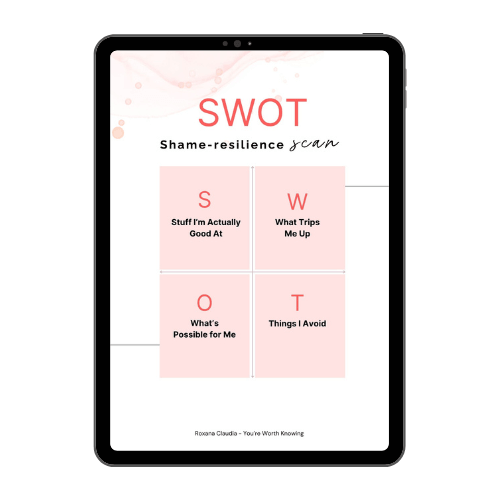
Shame-Resilience scan

Recent blog posts

Latest Episode

About the blogger

I'm Roxana Claudia

👋 Hi, I’m Rox. Let’s work on your self-worth. More than anything, I want you to believe you’re worth knowing instead of banking on external elements making that call for you.

Like what you see here?

Check out the blog!

Must Reads

Grab these freebies

Free Challenge

5 tasks. 3 difficulty levels. Test your social anxiety through exposure therapy.

Grab these freebies

Free Template

Get the template that I personally used and create your own steps for your journey.

A podcast meant to help you be comfortably you, no matter the situation. My goal is to give you the confidence to go out into the world, share your worth, build meaningful relationships, and see yourself as highly capable. It all starts with being your awkward self comfortably.

Subscribe to the newsletter

Hi, I'm Rox!

I spent years struggling with toxic shame, which often showed up as crippling social anxiety. It held me back in so many areas of my life, making me feel unworthy and paralyzed by fear. But through years of self-discovery and healing, I finally found the tools to break free from it.

I'm Roxana Claudia

Coach. Content Creator. Introvert. Mom. Lifelong learner. Psychology lover. Awkward human. Welcome.

An inner snapshot

Grab this free and editable worksheet to highlight specific strengths, weaknesses, opportunities, and threats from a personal standpoint.