

Social Anxiety
I started my journey to overcome social anxiety with this 5 step action plan
That version of me had social anxiety. Bad. The kind that lets you tell yourself your personality is “just introverted” when really you’ve been hiding for a decade.
What got me out of it wasn’t another self-help book. It wasn’t deep breathing exercises. It wasn’t a mantra app on my phone. It was a five-step action plan I wrote down on paper, ran for 90 days, and kept running for years. What I now know was, at its core, exposure therapy for social anxiety.
I just didn’t call it that at the time.
I’m not socially anxious anymore. I can now say that out loud without flinching. I run meetings. I write things on the internet under my own name. I make small talk in elevators without dying. The biggest change is that my confidence has increased tenfold.
This post is the action plan. Step by step, exactly what I did, plus the parts I’d add if I were rebuilding it now with everything I know.
Here’s the free template if you want to follow along.ost

You can experiment, tweak, and polish it to reflect your needs and be on your way. This is your action plan. Use the template and create your actionable steps toward a goal. Oh and it’s free!
Exposure therapy is the practice of deliberately doing the thing that makes you anxious in small and manageable steps until your nervous system stops treating it as a threat.
That’s it. That’s the whole thing.
The reason it works isn’t magic. It’s that anxiety isn’t a thinking problem; it’s a body problem. Your nervous system has decided that asking a question in a meeting = being eaten by a tiger. You can’t talk it out of that.
You have to repeatedly prove to yourself that nothing actually bad happens. The fear quiets down through evidence, not through reasoning.
Most people with social anxiety try the opposite. They avoid the thing. The avoidance feels like relief, so the brain learns: avoiding = safety. Which then makes the next encounter even scarier, because now your brain is even more convinced this thing is dangerous. That’s the loop you’re stuck in.
An action plan based on exposure therapy interrupts that loop. You don’t quit avoiding by force of will. You build a ladder of small actions that climb out of the loop one rung at a time.
Here are the five steps I used.
You’re going to work on this for 90 days, so make it specific.
My ultimate goal was: not to give a damn about what anyone thought of me. To disconnect from all the baggage and reservations that were holding me back from speaking and acting freely.
I couldn’t ask questions. I couldn’t share personal information about my life or any opinions I had. I wasn’t getting promoted. I wasn’t connecting with anyone around me. My goal was to fix this.
Some questions to help you write yours:
Examples of goals that work:
Write your goal in one or two sentences. Don’t overthink it. You can refine it later.
This is where most social anxiety advice falls apart. People tell you to “be more confident” or “just put yourself out there.” That’s not an action. That’s a vibe.
Actions are specific. Behavioral. They can be tracked.
Here were mine.
Action 1: Ask questions in meetings. Why? To stop fearing sounding stupid. I always feared sounding stupid or being too low down the food chain for anyone to listen to me. By keeping quiet, my confidence dipped with each passing day.
Action 2: Give others the benefit of the doubt. Why? To stop taking things personally. I used to be the type of person who was hurt by the smallest gesture. Walk by me without saying “good morning”? You must be pissed at me. Forget to add me to a group invite for Sunday brunch? You must not like me. Send me an email telling me how I should have done something? I’m going to get fired. I lost a lot of sleep over these thoughts.
Action 3: Say no. Why? To stop feeling guilty about my needs. I always tried to help everyone because I wanted to be known as the dependable one — and because I didn’t want anyone complaining about me in any shape or form. I was doing my job AND other people’s jobs. I realized eventually that my time was worth something too.
Pick your three. They should each tie directly to your ultimate goal — ask yourself “will doing this actually move the needle on the goal I just wrote?”
This is the part that makes it exposure therapy and not just goal-setting.
For each of your three actions, you’re going to break it down into 2-3 graduated steps — from lowest-stakes to highest-stakes. The first step should be barely outside your comfort zone. The last step should be something that feels genuinely scary right now.
Here’s how I built the ladder for each of mine.
Step 1 — Raise my hand. I never did well jumping into a conversation without being asked. So I started by raising my hand to emulate that feeling of being included on purpose. It gave me control. The only times I’d ever felt confident speaking up in school were when the teacher called on me or when I raised my hand, sure of myself.
Step 2 — Ask a question I already knew the answer to. Before every meeting, I’d think of a question to ask that I already knew the answer to. This let me speak up in a controlled environment without the risk of sounding stupid. I did this for months before moving on.
Step 3 — Write down questions I didn’t know the answer to. Once Step 2 felt natural, I started writing down real questions ahead of time — ones where I genuinely didn’t know the answer. The writing-down part was important because it let me check that the question made sense and didn’t take too much time. God forbid I’d somehow feel stupid.
Step 1 — Create a backstory. I’m highly sensitive, so I took everything to heart. I started putting myself in the shoes of whoever was bothering me, while thinking of this quote: “Be kind, for everyone you meet is fighting a battle you know nothing about.” — Ian Maclaren.
Once I started thinking up realistic alternative scenarios, I started seeing people in a different light — as people with problems and worries and to-do lists, not as the entire world being against me.
Step 2 — Put a time limit on it. If I was going to be affected by someone’s gestures or words, it was only allowed to live in business hours. I had to consciously not take work home. I’d talk about it with my husband for a few minutes, then put it down to revisit the next day. I was done with sleepless nights and anxious mornings.
Step 3 — Gauge the other person. When I needed to know whether I was being crazy, I’d strike up a conversation with the person who supposedly slighted me. Most of the time, I’d realize I’d fabricated the whole story in my head. If I sensed something was actually off, I could ask, “Hey — are you upset about something?” and take the conversation from there.
If you find yourself convinced everyone hates you after every conversation, this post on the Liking Gap is the science behind why your brain does that and why it’s almost always wrong.
Step 1 — Begin with a white lie. I’d been doing someone’s task for ages and was tired of being taken advantage of. So I introduced a “new process” — sent out a sheet, gave them a deadline, pretended it was about efficiency. Soon enough, the new process was in place, and I was off the hook.
Step 2 — Decline meeting invitations. I used to accept every invite. Here, there, everywhere. It was draining. I learned to hit the decline button. This became crucial after I had my son and needed buffer time to actually live my life.
Step 3 — Just say no, no excuse needed. I had to get comfortable saying no without dressing it up. “I’m drained, I need that time for myself” — and not apologizing for it. This was actually harder in my personal life than at work. The root cause for me was that I didn’t want to feel left out. Once I permitted myself to miss things, I realized people kept inviting me anyway.
The You’re Worth Knowing newsletter is where we practice being cringe over beige in real time.
Weekly letters to help you stop performing, start slaying toxic shame, and build a life that actually fits you – weird hobbies, awkward memories, and all.
You have successfully joined our subscriber list.
The mantras aren’t the magic fix. They’re the pre-game pep talk — what you say to yourself in the elevator before you walk into the meeting. The point is to give your nervous system something to grip while it’s panicking.
Here were mine.
For “ask questions in meetings”:
For “give people the benefit of the doubt”:
For “say no”:
Write yours. Make them blunt. They should sound like things you’d say if you were the friend you needed.
This is the step almost everyone skips and it’s the one that makes the framework actually compound.
You can’t see your own progress in real time. You’ll always think you haven’t moved at all. The 90-day debrief is where you sit down, look at where you started, and let yourself notice what’s different.
Here’s what I wrote in my own debrief, 90 days in:
Notice how each of those ties directly back to my original ultimate goal: not give a damn about what anyone thought of me. The proof was in the behaviour, not in how I felt.
This is the principle that took me years to learn: the behaviour comes before the feeling. You don’t wait until you feel confident to ask the question. You ask the question, and the confidence shows up later.
I focused on those three actions. But the progress I made there spilled into the rest of my life in ways I didn’t predict.
Within five years, I was able to:
The action plan was for social anxiety. But what it really did was teach me that I was allowed to take up space.
I want to be honest with you about something most “overcome social anxiety” content lies about.
This isn’t a 90-day fix. The 90-day plan is the first round. You’ll do it, you’ll notice progress, and then you’ll pick a new goal and do it again. The change takes years. There’s no version of this where you do one round of work and never have to think about it again.
What changes is your relationship to the discomfort. You stop being scared of the discomfort. You start trusting that you can sit in it and the world doesn’t end. That’s the actual shift.
So don’t measure yourself against where you want to be at the finish line. Measure yourself against where you were 90 days ago.
If you want to actually do this — instead of just reading about it — two things’ll help:
1. The free Social Anxiety Action Plan template. It walks you through all five steps in a fillable document. It’s the same template I used. Get it here.
2. The Social Anxiety Challenge Workbook. Once you have your action plan, you need exposures to actually run. The workbook gives you 35 ready-made challenges across three difficulty levels, with reflection prompts for each one. Think of it as the gym equipment for the action plan. You can get it here.
You don’t have to start with both. Start with the template, fill it in, sit with it for a week. If you want to go deeper, the workbook is waiting.
I’m going to leave you with the line I tell myself on days when I think I haven’t made any progress at all:
The change takes years. You have to be prepared for that with deliberate, day-to-day actions.
You’re already further along than you think. The fact that you Googled “exposure therapy for social anxiety” and read this far is evidence. That’s an exposure. You did one without even noticing.
You’re going to be okay.
This is my original action plan that kickstarted my entire journey to overcome social anxiety. I’m giving you my exact steps.
Here’s the 5-step action plan:
Go back and read why each step is essential in the action plan.

I went from being scared to ask a question out loud to hosting summits online. I love coffee, French crepes, and working from home.
My mission? Help others dismantle their toxic shame so they can make friends, have conversations, and be comfortable around people!
Did you find value in my content? Buy me a coffee!
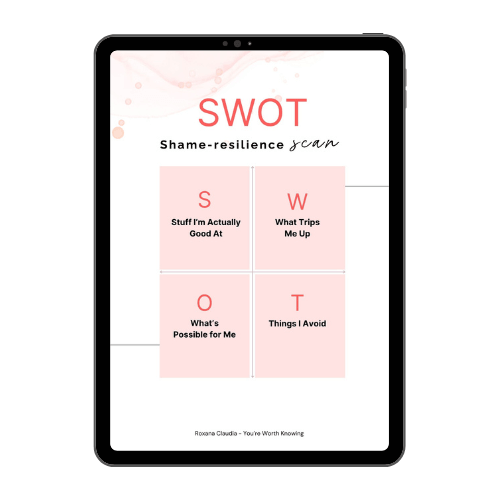
Grab the free
Shame-Resilience scan

👋 Hi, I’m Rox. Let’s work on your self-worth. More than anything, I want you to believe you’re worth knowing instead of banking on external elements making that call for you.
Like what you see here?
Check out the blog!
Must Reads
Grab these freebies

Free Challenge
5 tasks. 3 difficulty levels. Test your social anxiety through exposure therapy.
Grab these freebies

Free Template
Get the template that I personally used and create your own steps for your journey.
A podcast meant to help you be comfortably you, no matter the situation. My goal is to give you the confidence to go out into the world, share your worth, build meaningful relationships, and see yourself as highly capable. It all starts with being your awkward self comfortably.
Subscribe to the newsletter
The You’re Worth Knowing newsletter is where we practice being cringe over beige in real time.
Weekly letters to help you stop performing, start slaying toxic shame, and build a life that actually fits you – weird hobbies, awkward memories, and all.
You have successfully joined our subscriber list.

I spent years struggling with toxic shame, which often showed up as crippling social anxiety. It held me back in so many areas of my life, making me feel unworthy and paralyzed by fear. But through years of self-discovery and healing, I finally found the tools to break free from it.
Grab this free and editable worksheet to highlight specific strengths, weaknesses, opportunities, and threats from a personal standpoint.


