

Social Anxiety
A personal story (made out of two situations) that made me come to this realization
Let’s talk about confrontation, but more specifically, how to handle the on-the-spot kind, when someone reproaches you out of nowhere, and your brain goes blank.
I have a feeling this is something you also try to avoid as much as possible.
If you have social anxiety, fear of confrontation probably runs your life more than you’d like to admit. Conflict and social anxiety do not go hand in hand.
Socially anxious people might prefer to leave, ghost, or do anything to avoid a confrontation. But it is possible to engage in conflict and still feel at peace with yourself.
It’s not easy. It’s a process. It’s a journey. It takes effort. But there are things you can do. And trust me… my whole life, I did everything to avoid conflict.
I’ve avoided uncomfortable conversations because I didn’t want to upset anybody. I used to be okay with being upset and disappointed at others, but I wasn’t okay with others being disappointed or upset with me.
How dare I speak my truth and share my opinions?
For many years, I’ve allowed other people’s truths and opinions to rule over mine, even when those were damaging to the general well-being of society.
And it comes down to learning how to speak at the right moment in time.
While yes, it’s uncomfortable, conflict does create the change that we all seek.
I hated conflict so much that I tended to apologize even when I knew I was right, just so that it would go away. But I’m here to tell you that the conflict does not go away. It continues deep within us.
We replay the discussion over and over in our heads with logical and reasonable comebacks. We always know what to say after the fact. After we’ve calmed down.
But it’s too late, because by then we already hate ourselves for not having the courage to say anything at the right time.
“If you avoid conflict to keep the peace, you start a war inside yourself.”
Because of course, conflict doesn’t magically disappear. We become the outlet.
This article isn’t about conflict with the people in your life. It’s about on-the-spot conflict. The kind that arises out of nowhere and makes your blood boil instantly.
The moment when you know you should say something, but don’t, because you’re too scared it will lead to you being punched by a stranger. But the alternative of holding it in isn’t much healthier.
I want to walk you through how to handle on-the-spot confrontation so you walk away at peace with yourself.
If you Google how to handle conflict, there are many articles, and they’re excellent ones. They all revolve around one core piece of advice:
Whatever you do, do not bottle up your thoughts and emotions. Let the other person know, or else you will implode.
That can be very hard for most of us, especially with social anxiety. So this advice never really worked for me, because I always chose to bottle things up and take the hit.
Those articles contain a lot of good advice, but don’t take everything at face value. You need to assess your temperament and personality and see where it fits.
While I was going through the articles, I realized that none of them address on-the-spot conflicts, where you only have a few seconds to address the other person. Otherwise, the opportunity will be lost forever.
And it’s not about making a good impression, especially if someone does something malicious or unjust.
It’s about saying what you want and going home without feeling like you bottled things up.
Nothing worse for me than to walk away from someone and feel like I wasn’t true to myself. All because I wanted them to like me, or not have a bad impression of me. Ugh. Yuck.
If your default mode is to retreat from any conversation that might get heavy, this post on why you might not want to talk to anyone right now covers what’s actually happening — and when avoidance becomes a problem
Here are three immediate steps you can take to give your brain space to think and respond accordingly.
I said accordingly because the first order of business is ensuring your anger isn’t displayed. You do not want to be emotional or come off as angry.
People shut down at people who come at them.
So let’s say you’re being reproached or reprimanded for doing something you think is within your rights, or that doesn’t disturb someone else’s peace.
While all of these are perfectly natural responses, here’s what I want you to try instead:
Yes, it sounds counterintuitive, but think about it for a second. You’re probably feeling anger, resentment, shame, embarrassment which are mostly negative emotions.
You need to push those to the back of your mind. It’s hard to be rational when you’re experiencing those emotions.
Smiling will center you, help you stop the onslaught of emotions, and trip the other person up because they’re probably expecting a very different reaction.
Sometimes, we need time to assess a situation and decide how to respond. So try to buy some time.
You want to avoid spitting out what’s on your mind, since that’s when you usually regret it the most. Refrain from responding out of line.
What helps is to repeat back what the person said, as much as you can, as a statement.
Some people will realize how unreasonable they’re being once you say it back. Others will keep going and give you more information, which gives you even more time to think about how to respond.
At this point, you’ve collected yourself and are in a much more stable state of mind. Before you give this person a piece of your mind, ask yourself:
1. Did I do something wrong?
If yes, explain your thought process to the person without any emotional outbursts. Let them know what led to your action or words. If your answer is no, move to the next question.
2. Why does this person feel this way?
You’re a great observer and very self-aware, so you can easily put yourself in someone else’s shoes. You can usually figure out why this person was ticked off.
Once you pinpoint what they’re upset about, address it the way you would with a five-year-old. When my son has a full-blown tantrum, I immediately deflect by stating his feelings and why.
By defining the emotion and labeling it, the person feels immediately understood. People usually back off when they feel heard.
3. How can I resolve this so I walk away unconflicted inside?
This is the trickiest question, but you should feel calmer by now. Here you either choose to continue with whatever it is you were doing that pissed the other person off, or you decide to apologize and stop.
I often feel better when I apologize. Other times, it makes me sick if I do, because I might have violated my principles.

Managing your social anxiety starts with not avoiding it. Yes, it’s a painful truth, but sitting at home, hoping it will magically disappear, never worked for anyone.
Start slowly, but start with a task!
Let me show you how this works in practice using an incident in the news.
A man was birdwatching in Central Park when he noticed a woman was walking her dog off-leash, which was against park rules.
He confronted her, walked up, and asked her to put the leash on the dog. Now imagine you’re the woman, and someone is reprimanding you for not following the rules.
Step 1: You freeze and smile at the man to avoid escalating.
Step 2: You repeat what he said. Something like: “Hi, you want me to put a leash on my dog here in the park, right?”
He’ll probably explain that it’s against park rules, and that he wouldn’t feel comfortable if everyone walked their dog this way.
Step 3: Now you ask the three questions.
You can label his feelings: “I hope I’m not making you uncomfortable. He’s an adorable dog, and he stays by my side. I know it’s against park rules, but there’s no one here, and he loves running around.”
Two alternatives. Both valid. Which one you choose depends on what comes next.
Whatever you do, you have to ask yourself: how important is it for you to “win”?
Is one of your principles threatened? Will you regret not saying anything? Only you know that.
The Central Park scenario is a minor violation of park rules. But some situations will get you incensed and make your blood boil. In those moments, it’ll be harder to remain calm, smile, and repeat what they’re saying, but following this formula will ground you and keep you steady.
Which is a better alternative than walking away with that anger, taking it home, and taking it out on your family?
That’s not to say you should take it out on a stranger by any means. But if you have the tools to resolve it on the spot, then I recommend you do that.
The more you practice these steps, the easier it is to respond appropriately.
I tend to find on-the-spot conflicts much harder to stomach than those with people I know. With people I know, I can give myself time to think, cool down, and get back to them. I can marinate my words for days before sharing them.
With on-the-spot conflict, we don’t have that luxury.
You don’t have the luxury to marinate your words or put things together eloquently. The words have to find a way out in time, or else they will sit with you, and that’s what you want to avoid at all costs.
Hopefully, you won’t encounter too many of these situations, but try these steps the next time and see how you feel.
If you run into a conflict like this and you have a hard time following some of the steps (which is understandable), don’t hold your anger in.
Go home and write your thoughts out. Put them on paper. Don’t bottle your emotions. Do whatever it takes to shake it off and get them out of your body.
If you’re out and about, and someone reprimands you, there are a few things you can do to stay calm during this on-the-spot conflict that arises.
The 3 steps are:
Practice this formula so that you don’t take home your anger because you were too scared or worried to say something.

I went from being scared to ask a question out loud to hosting summits online. I love coffee, French crepes, and working from home.
My mission? Help others dismantle their toxic shame so they can make friends, have conversations, and be comfortable around people!
Did you find value in my content? Buy me a coffee!
Grab the free
Shame-Resilience scan

👋 Hi, I’m Rox. Let’s work on your self-worth. More than anything, I want you to believe you’re worth knowing instead of banking on external elements making that call for you.
Like what you see here?
Check out the blog!
Must Reads
Grab these freebies

Free Challenge
5 tasks. 3 difficulty levels. Test your social anxiety through exposure therapy.
Grab these freebies

Free Template
Get the template that I personally used and create your own steps for your journey.
A podcast meant to help you be comfortably you, no matter the situation. My goal is to give you the confidence to go out into the world, share your worth, build meaningful relationships, and see yourself as highly capable. It all starts with being your awkward self comfortably.
Subscribe to the newsletter
The You’re Worth Knowing newsletter is where we practice being cringe over beige in real time.
Weekly letters to help you stop performing, start slaying toxic shame, and build a life that actually fits you – weird hobbies, awkward memories, and all.
You have successfully joined our subscriber list.

I spent years struggling with toxic shame, which often showed up as crippling social anxiety. It held me back in so many areas of my life, making me feel unworthy and paralyzed by fear. But through years of self-discovery and healing, I finally found the tools to break free from it.
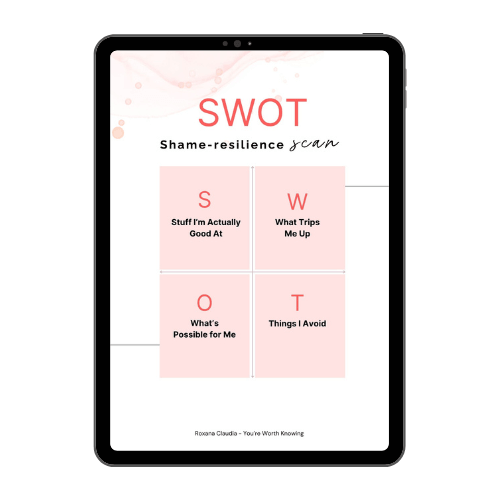
Grab this free and editable worksheet to highlight specific strengths, weaknesses, opportunities, and threats from a personal standpoint.


