Social Anxiety
Let’s break down 5 studies so that we can feel better about interacting with new people
If your brain asks why do I think everyone hates me after every normal conversation, keep reading. You’re not alone.
Have you ever walked away from a conversation with someone new, thinking you tanked it? That there’s no way they’ll ever want to talk to you again?
Maybe because of something you said or didn’t say. Perhaps because they didn’t give you the feeling that they liked you in the first place?
Chances are, you were a victim of the liking gap. Even if you haven’t heard of it, you’ve probably experienced this illusion.
The ‘liking gap‘ is an illusion that creates the mistaken belief that someone likes you less than they do. Imagine you’re baking a cake and are unsure if it will turn out well. You’re worried it might not be sweet enough. But when you serve it to your guests, they all love it.
This is similar to the liking gap in social interactions…we often underestimate how much others like us.
Now I know what you’ll say: They’re just saying that about my cake to be nice.
Sure, that’s a possibility. Let’s reframe it, then.
Think of a time when you were the one being served cake, and you found it delicious!
Chances are, the person who made it was also worried about its taste. Maybe they even mentioned how worried they were or breathed a sigh of relief when you said it was delicious.
My dad is very critical of his cooking and always asks 10 times if it’s good enough once it’s served, yet I always look forward to his dishes the most.
If your brain is the kind that constantly asks, “Why do I think everyone hates me?” after every social interaction, then keep reading. You’re not crazy, you’re not broken, and you’re definitely not alone. The science will back you up here.
Because your brain is convinced you messed something up, and it wants to find the proof.
After a conversation, you’ll mentally rewind it. You’ll catch every weird pause, every laugh that came out a little too loud, every moment you weren’t sure what to do with your hands. And then you’ll decide: they thought I was annoying. They thought I was boring. They didn’t like me.
It feels like an analysis. It’s not. It’s your nervous system scanning for rejection, and it’s going to find some, even when there isn’t any.
You’re not thinking. You’re being mean to yourself, on a loop. And that loop has a name now.
To set the stage, I want to highlight the Liking Gap to make you feel more comfortable meeting new people.
We’re so reluctant to talk to strangers or with the person sitting next to us in class because we worry they won’t like us or find us interesting enough.
But what if the truth is on the other side? What if you knew that the chances were SUPER HIGH that the person DOES find you interesting?
Yes, having a conversation with a stranger or a new person is quite unnerving, especially if you have social anxiety, as it can be awkward and uncertain.
“Did I overshare? Talk too much? Was I boring?”
And since you’re in your head, your guess will be negatively biased and self-critical. Ugh, those stupid brains of ours.
And since you’re the best at being your worst critic, you will find it hard to believe others don’t see you the same way. There’s the illusion!
The gap between what you think of yourself during a conversation and what someone else thinks of you is so big that you will underestimate how much they like you and overestimate how harshly they feel about you.
But the truth is, if you ask someone how much they like you, they will probably give you two thumbs up.
Studies show that after people have conversations, they are liked more than they think. I find that quite reassuring, knowing I have science backing me up in a conversation with a stranger, don’t you?
Let’s dig more into the data.
Participants were recruited and asked to have a conversation with each other. They sat face to face at a table, were given some ice-breaker questions to help guide the conversation, and were recorded for the duration.
After the conversation, they were asked to rate how much they liked their conversation partner and how much they thought their partner liked them. The answers were based on a scale of 1-7 (show picture of scale), and they had to agree or disagree with several statements, such as:
And so on.
After a long of mumbo-jumbo statistics that I’m not going to break down because, holy moly, I did enough of that during my Master’s degree and hated it.
The final call was that even after a short encounter with someone (aka small talk) people significantly underestimated how much others liked them.
Now they have also added shyness to the mix. Highly shy participants reported a larger liking gap, while those with low shyness did not report a significant gap.
Huh? What gives with the non-shy folks?
Does that have to do with confidence? They’re not sure, but it does explain why some people find it so easy to talk to just about anybody without tripping up or thinking poorly of themselves, and that the whole world hates them.
You can probably think of a few times that you signaled to someone that you wanted to be friends with them, but they never really reciprocated, making you feel like they wanted nothing to do with you.
Chances are that they ignored your signal.
When we communicate with each other, we send a lot of signals through words, gestures, and facial expressions. Yet, for some reason, we miss many of those.
Well, that’s not true; it’s not SOME reason.
It’s for THIS reason: We tend to focus so much on our own performance and thoughts about our performance that we pay no attention to the person in front of us.
For all we know, they could literally be saying, “I like you,” or “I think you’re cool,” and you’d gloss over it because you’re too busy being mean to yourself.
But we’ll get to this in study #2.
Back to the original question: Do people send signals that they like each other? The researchers separated the signals into two buckets:
The researchers can only truly measure based on the neglected-signal bucket since they cannot know whether one participant liked another if they showed no signals, right?
And that’s where the liking gap lives: in the neglected signal bucket. Because the participants DID signal that they liked one another, but their ratings showed otherwise.
When rating how much their conversation partners liked them, they didn’t consider the signals.
So how did the researchers observe these so-called signals that we all seem to ignore in our conversations?
They had trained coders watch the recorded conversations and rate the participants’ Liking for each other.
What this means is that they had trained research assistants who were unaware of the study’s purpose, watched the recorded conversations, and answered questions such as:
Sounds fun; I’d love to do that!
The answers were recompiled against the 7-point scale. The analysis showed that observed Liking was a significant predictor of actual Liking. In layman’s terms, the coders could accurately predict how much participants reported liking one another.
So, if someone is having a conversation with a stranger, they would pick up on signals and predict whether or not we are interested in each other.
Which brings us to the crux of the issue: why are we so bad at judging how others feel about us if chances are that they think rather highly? In the context of talking to someone new.

If your brain runs the “everyone hates me” loop after every social interaction, my free Social Anxiety Action Plan is a good place to start. It’s the template I personally used to get out of the negative loops I found myself in. I hope it helps you just as much!
Check your inbox to download the free template!
Why, oh why, can’t we all be friends like we want to be and stop overthinking that nobody likes us?!
So, although people give us signals that they like us during a conversation, we neglect these signals when it comes to rating how much they like us, and this has something to do with the fact that we’re too busy with our inner critic to catch the signals.
Which is what they set out to prove.
For this round, they placed the participants at the table again but did not give them any pre-determined ice-breaker questions (like in study #1a).
They let them have a natural conversation for about 5 minutes.
After the conversation, the participants rated each other with the same questions and scale as the first study, but they were also asked to share their post-conversation thoughts.
They were asked to write in detail about each moment and then to rate each moment negatively or positively on a 7-point scale whose endpoints were labelled extremely negative and extremely positive.
This helped the researchers test whether the negativity of people’s post-conversation thoughts was related to the size of the Liking Gap.
They call this the “thought valence.”
“Thought valence” refers to the positivity or negativity of a person’s thoughts and how it influences the other two variables: rating type (actual or perceived liking) and the liking between conversation partners.
Yes, the jargon is in the way, I know. Stick with me here.
As a result, they found a significant effect, where “thought valence” (our positive/negative thoughts) plays a role in determining how much participants liked one another after their conversation.
The difference between actual and perceived liking might be due to the positivity or negativity of their thoughts during the interaction.
Phew, mouthful.
In plain English: the more negative your thoughts during and after a conversation, the bigger your liking gap. The stronger the negativity → the stronger the gap.
Moving on from the small talk – does the illusion follow us in longer conversations?
For this study, they had participants talk for as long as they wanted within time constraints (longer than a minute but less than 45 minutes).
They even measured an Enjoyment Gap (how much someone enjoyed a conversation and how much they think the other person enjoyed it).
After their conversation ended, they went into separate rooms and answered the following questions, based on the 7-point scale again:
Conversations lasted anywhere from two to 45 minutes. As it turned out, the rating type (actual or perceived) significantly predicted liking, again showing that we underestimated how much others liked us.
If you guessed that participants mistakenly believed they enjoyed the conversation more than the other person, you’re right, my friend!
They even grouped the conversations into three buckets to see if there were any additional observations to be made and if the liking gap persisted across them:
You can see it in this graph right here.
For each conversation instance, the perceived-liking bar is below the actual-liking bar.
This shows that no matter the length of the conversation, participants rated themselves as being less liked than the rate their conversational partners gave.
Ta-da, the illusion lives on!
Participants who had longer conversations reported greater enjoyment, but regardless of conversation length, they still underestimated how much their conversation partners enjoyed it.

It’s time to stop sabotaging yourself and start believing you’re worth knowing. Get the tools you need to build social confidence, manage social anxiety, and rock conversations.
Now comes the most interesting outcome.
The studies we just discussed were based in a laboratory setting where they had participants come in for the purpose of the study (even though they didn’t know what was being measured).
This next study takes it to the real-world level.
Dun dun dun, there’s nowhere to run anymore if the liking gap persists here.
They wanted to find out whether the Liking Gap exists in the general public, so they had people do their ratings after a How to Talk to Strangers workshop.
What they had to do was the following:
The researchers asked people how interesting they found their conversation partner and how interesting they thought their conversation partner found them — both before and after the conversation.
The “before” question was something like “How interesting do you think this person will be?” and the “after” question was “How interesting was that person?”
And also, of course, to rate what they think the other person would say about them.
I think you know where this is going.
As it turned out, from the 100 people there, the participants predicted that both they and their conversation partner would be less interesting than they actually were.
This tells us that a conversation with a stranger, it seems, is better than you think it will be.
You can again see in the graph that the perceived rating was lower than the actual rating, signifying the liking gap.
Finally, the researchers wanted to know whether the liking gap actually fades — or if at some point we start seeing this illusion for what it is.
I won’t go too in-depth with this one, but they assessed participants at various times (these were college roommates) to see the extent of the Liking Gap. And it persisted for several months as they formed and developed new relationships.
People underestimated how much their roommates liked them at every time point — except the final one.
So there was a Liking Gap between September and February, but then it disappeared in May.
That may be due to people getting to know one another well by that time, or because the students were deciding whether to live together the following year (which may have forced discussions that revealed liking) — or both.
So eventually, the gap closed.
Overall, the main message from these studies is that others like us more than we know. Or more than we think we know.
While you digest all of that, here are a few reasons for the liking gap’s existence:
We tend to focus on our flaws and mistakes during conversations. We’re more critical of our performance than an observer would be, as we saw with the coders. This is also called the spotlight effect.
While we’re aware of our own thoughts and feelings during a conversation, we have no clue about the thoughts and feelings of the person we’re talking to. This can lead us to make assumptions, misread, and misjudge the interaction.
We tend to fear rejection and disapproval from others, which makes us shrink. We downplay any positive moments during a conversation, which makes us underestimate how liked we actually are.
The Liking Gap shows up around age 5, when kids start caring about how others see them — and it grows stronger with age. Once they start caring about their “reputation,” the Liking Gap appears.
Now that we’ve gone through the definition, the studies, and the evidence for the Liking Gap, you’re more aware of your tendency to underestimate yourself when talking to someone new.
I hope this helps you put things into perspective so you’re less harsh on yourself and more open to the signals being sent your way.
Because if you’re consistently underestimating yourself in a conversation, you’ll run into self-doubt, lower self-esteem, and missed opportunities to connect with others meaningfully.
If you want to actually start practicing this — instead of just reading about it — the Social Anxiety Challenge Workbook gives you 35 tasks across three difficulty levels, with reflection prompts for exactly the kind of brain that replays conversations for three days. You do the task. You debrief on paper. You start building an evidence pile that your inner critic can’t argue with.
And if you’re looking for lower-stakes places to start, making friends online and talking to strangers are the easiest on-ramps for collecting that evidence in the first place.
And that’s a shame, isn’t it? Because you’re worth knowing.
If you haven’t heard of the “liking gap,” get ready to have your mind blown. It’s probably why you think the person you’re talking to isn’t enjoying the conversation.
In this article, I break down 5 studies that answer the following questions:


I went from being scared to ask a question out loud to hosting summits online. I love coffee, French crepes, and working from home.
My mission? Help others dismantle their toxic shame so they can make friends, have conversations, and be comfortable around people!
Did you find value in my content? Buy me a coffee!
Grab the free
Shame-Resilience scan

👋 Hi, I’m Rox. Let’s work on your self-worth. More than anything, I want you to believe you’re worth knowing instead of banking on external elements making that call for you.
Like what you see here?
Check out the blog!
Must Reads
Grab these freebies
Free Challenge
5 tasks. 3 difficulty levels. Test your social anxiety through exposure therapy.
Grab these freebies
Free Template
Get the template that I personally used and create your own steps for your journey.
A podcast meant to help you be comfortably you, no matter the situation. My goal is to give you the confidence to go out into the world, share your worth, build meaningful relationships, and see yourself as highly capable. It all starts with being your awkward self comfortably.
Subscribe to the newsletter
The You’re Worth Knowing newsletter is where we practice being cringe over beige in real time.
Weekly letters to help you stop performing, start slaying toxic shame, and build a life that actually fits you – weird hobbies, awkward memories, and all.
You have successfully joined our subscriber list.

I spent years struggling with toxic shame, which often showed up as crippling social anxiety. It held me back in so many areas of my life, making me feel unworthy and paralyzed by fear. But through years of self-discovery and healing, I finally found the tools to break free from it.

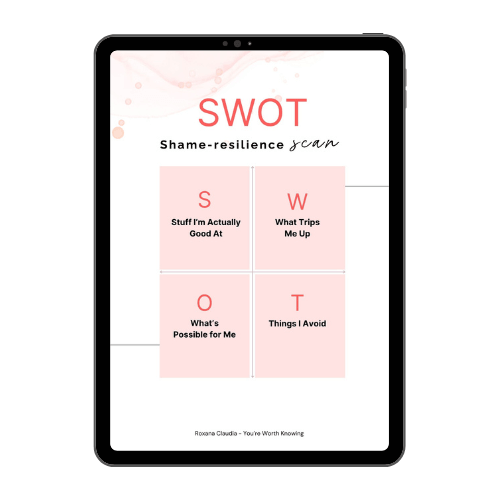
Grab this free and editable worksheet to highlight specific strengths, weaknesses, opportunities, and threats from a personal standpoint.